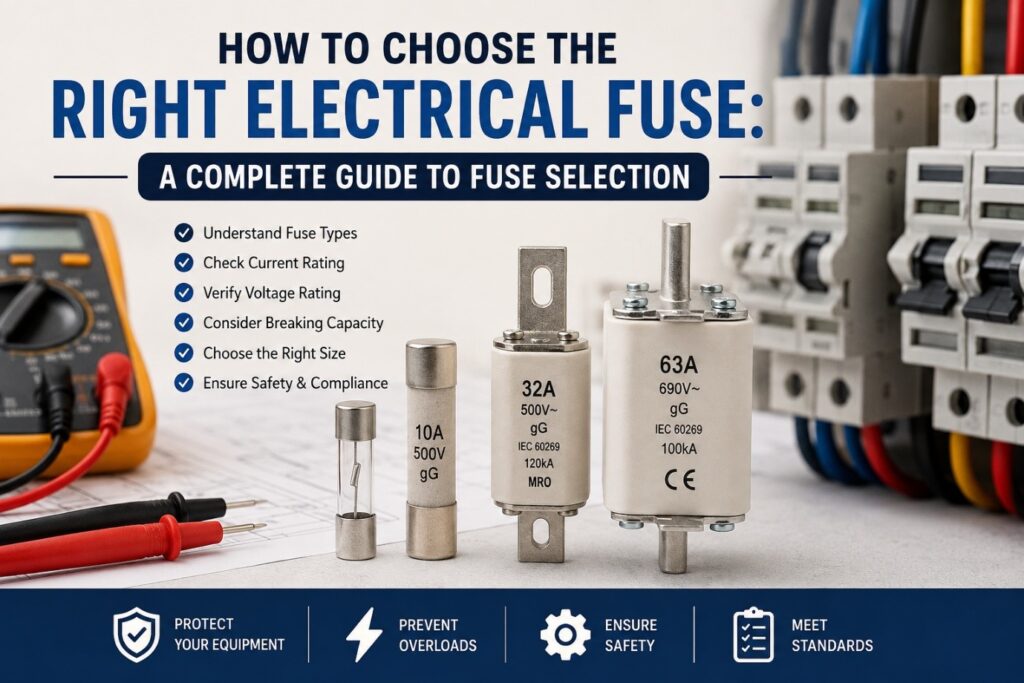
An electrical fuse is a sacrificial protection device: it opens the circuit when excessive current passes through it, preventing damage to equipment, wiring, and the wider power system. Fuses are used extensively across steel, aluminium, cement, cable manufacturing, renewable power, power generation, switchgear and energy storage applications.
The right fuse must match the electrical characteristics of the application. A poor choice either under-protects the circuit or causes nuisance interruptions. In the UAE specifically, ambient temperature derating deserves extra attention — fuses rated without accounting for Gulf summer heat can trip earlier than expected. When selecting a fuse, consider: operating voltage, normal operating current, available fault current, interrupting rating, fuse class and construction, equipment type and application, and operating ambient conditions.
The earlier version of this guide covered three classes. Sabana Traders’ actual catalogue is much wider — here’s the full picture, grouped by standard.
Class J — Space-saving, industrial/commercial circuit protection with high interrupting capacity.
Class T — Very small footprint with a high interrupting rating — used where space is tight but fault currents can be severe.
Class RK-5 — Current-limiting fuse for general circuit and apparatus protection; verify voltage, amperage and interrupting rating for the specific application.
Class CC — Compact branch-circuit protection, common in control circuits and motor branch circuits.
Class G — Low-amperage circuit protection, typically for lighting and small branch circuits.
Class L — High-amperage protection for main service entrances and large feeders.
Midget Fuses — Compact-format fuses for control transformers and small branch circuits.
A2Y/A6Y — Specialised UL fuse series for specific OEM and equipment protection needs.
NH Fuses — Blade-contact fuses widely used in European-standard industrial panels.
IEC Cylindrical — Cylindrical-body fuses for general IEC-standard distribution circuits.
Miniature Fuses (IEC) — Small-format protection for control and instrumentation circuits.
PV Fuses — Purpose-built for solar PV strings and DC protection — relevant to the UAE’s growing solar sector.
DO Fuses — Screw-in diazed fuses used in distribution boards across older and hybrid IEC installations.
For drives, rectifiers and semiconductor-adjacent applications, Mersen’s high-speed fuse range (including North American/AMP-Trap, square body, IEC and NH DIN/BS formats) clears faults fast enough to protect sensitive power electronics before they’re damaged.
For transformer, motor and switchgear protection above low-voltage distribution, see Mersen High & Medium Voltage Fuses and SIBA High/Medium Voltage Fuses. SIBA also supplies miniature fuses and ultra-rapid semiconductor fuses for power-electronics protection.
Class | Typical Application | Footprint | Interrupting Rating | Best For |
Class J | Industrial/commercial circuits | Space-saving | 200,000A (200 kA) — UL 248-8 standard | General industrial protection |
Class T | High fault-current areas | Very compact | 200,000A (200 kA) — UL 248-15 standard | Tight enclosures, panel retrofits |
Class RK-5 | General circuit/apparatus protection | Standard | 200,000A (200 kA) AC — UL 248-12 standard | Broad industrial use, current-limiting |
Class CC | Control & motor branch circuits | Compact | 200,000A (200 kA) — UL 248-4 standard | Control panels |
Class G | Lighting/small branch circuits | Compact | 100,000A (100 kA) — UL 248-5 standard | Low-amperage circuits |
Class L | Main service/large feeders | Large | 200,000A (200 kA) — UL 248 standard | Service entrances, main feeders |
NH (IEC) | European-standard panels | Blade-contact | Series-specific — confirm per IEC 60269 datasheet | IEC-standard installations |
Both are genuine, standards-tested manufacturers. As a general starting point: Mersen’s catalogue covers the widest range of UL and IEC low-voltage classes plus high-speed and MV fuses, making it a strong fit for mixed low-voltage distribution needs. SIBA is widely specified for HV/MV substation work, miniature control-circuit protection, and ultra-rapid semiconductor protection. The right choice always depends on your specific system — Sabana Traders’ technical team can confirm the exact fit for your application.
How do I choose the right electrical fuse?
Start with the circuit’s operating voltage and current, then check available fault current and required interrupting rating, and finally match the fuse class, physical size and mounting to your existing fuse blocks or disconnects.
What factors should be considered when selecting a fuse?
Voltage rating, current rating, interrupting rating, fuse class/construction, ambient temperature, and the equipment or application being protected.
What are the different types of industrial fuses?
Broadly: UL/CSA classes (J, T, RK-5, CC, G, L, Midget, A2Y/A6Y), IEC types (NH, cylindrical, miniature, PV, DO), high-speed fuses for drives and power electronics, and medium/high voltage fuses for transformers and switchgear.
What is the difference between Class J, Class T, and Class RK-5 fuses?
Class J is a space-saving industrial standard; Class T has a very small footprint with a high interrupting rating for tight enclosures; Class RK-5 is a current-limiting fuse used broadly across general industrial and apparatus protection.
Why is interrupting rating important when selecting a fuse?
It’s the maximum fault current the fuse can safely interrupt. A fuse rated below the system’s available fault current can fail to clear the fault safely, risking equipment damage or an arc flash event.
Does Sabana Traders supply all these fuse classes in Dubai and the UAE?
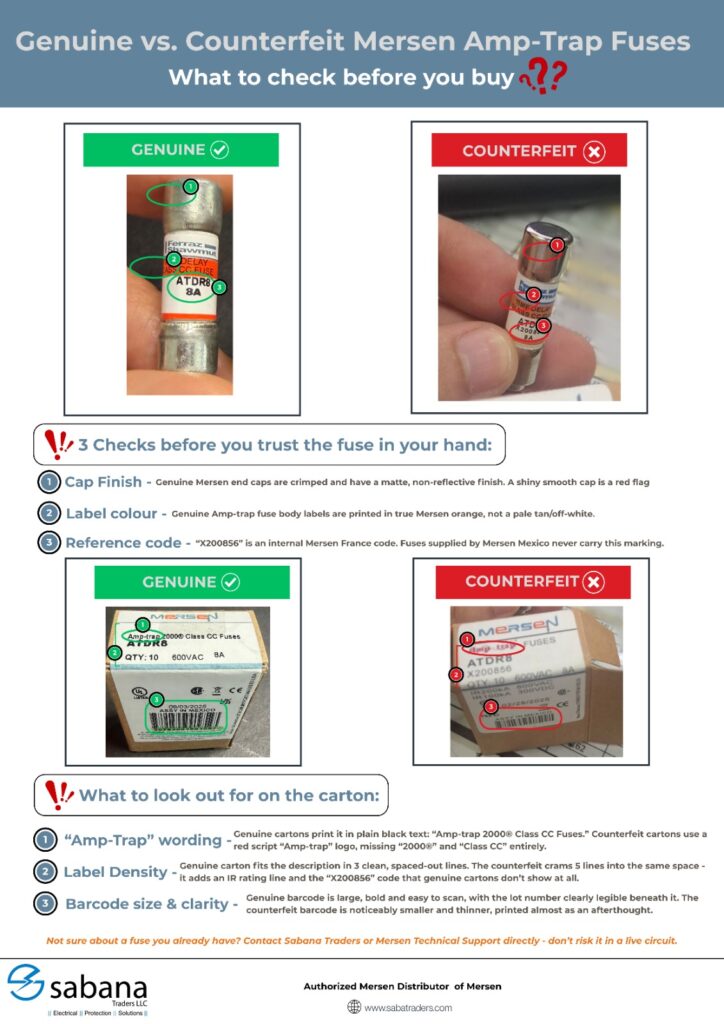
Yes — Sabana Traders supplies genuine Mersen and SIBA fuses across the full range covered in this guide, from low-voltage UL/IEC classes through to medium and high voltage protection.
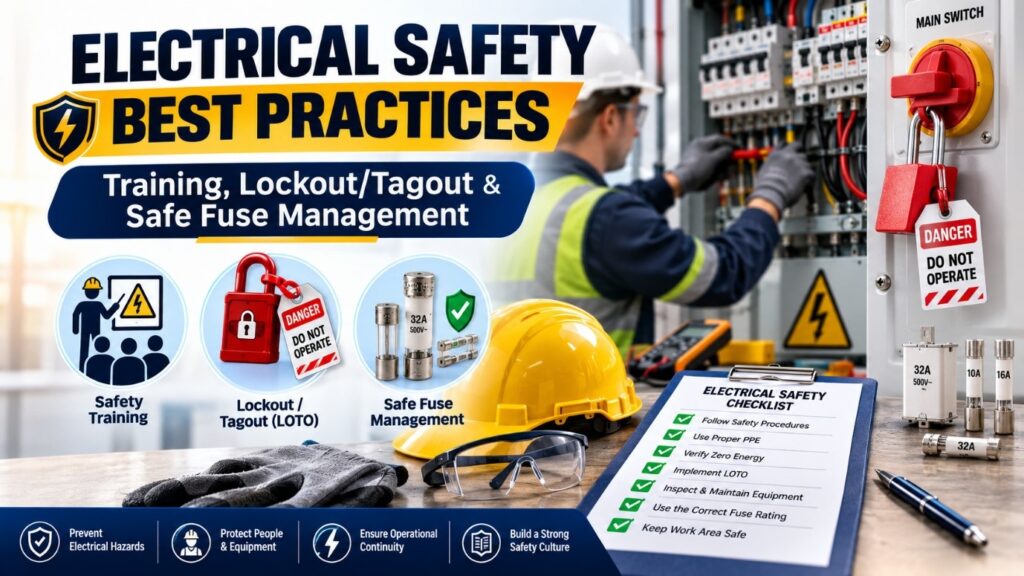
Choosing the right fuse comes down to matching class, rating and construction to your system’s real operating and fault conditions — not just picking a familiar part number. Once your fuse protection is selected, the next step is making sure the surrounding system design and safety procedures are built around it. Sabana Traders supplies genuine Mersen and SIBA fuses across every class covered here, with technical support to confirm the right fit for your application.


© 2025 Sabana Traders LLC. All Rights Reserved | Developed and Managed by ysofttek.com
WhatsApp us