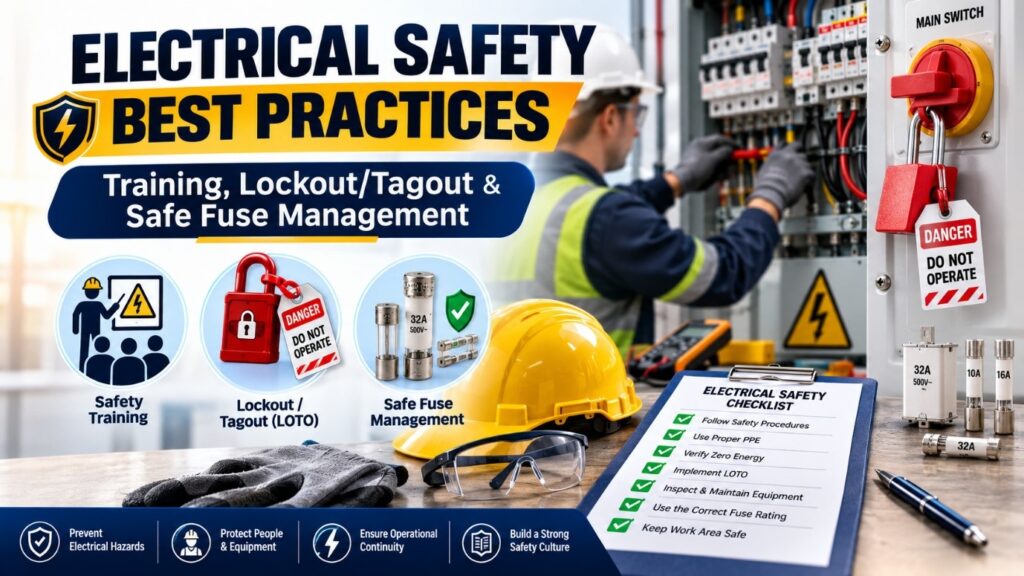
Electrical hazards — shock, arc flash, fire, equipment malfunction, costly downtime — occur wherever a facility lacks a proper safety programme. An effective programme needs the right protective equipment, adequately trained employees, well-defined operating procedures, and regular inspection and testing, in line with UAE workplace safety requirements.
Workplace risk management should include regular electrical safety training covering hazards, safe operating procedures, emergency response and correct use of PPE for anyone working around electrical equipment. Equipment-specific procedures, isolation steps, required inspections and safe maintenance should all be included, with refresher training whenever the system or equipment changes.
Lockout/tagout ensures equipment cannot be re-energised during maintenance or servicing. Before starting a task, authorised personnel must identify all energy sources and lock out the equipment following a defined procedure:
Where possible and permitted by company procedure, workers must de-energise equipment before inspection, repair or maintenance, then verify no power is present before proceeding. Only qualified, authorised employees should perform isolation or restoration.
Safety procedures alone aren’t enough if the protection equipment behind the panel isn’t suited to the fault levels it’s exposed to. This is where fuse choice becomes a direct safety factor, not just a technical one — and it’s the piece most safety guides leave out.
Current-limiting fuses, such as Mersen’s high-speed range and Mersen surge protection devices, restrict how much fault energy reaches downstream equipment — which can change the arc flash incident energy category a technician is exposed to, and therefore the PPE required for the task.
Fast-clearing MV/HV fuses, such as SIBA’s High/Medium Voltage range and SIBA’s Ultra Rapid Semiconductor Fuses, shorten the time a fault stays energised, reducing the exposure window for anyone performing isolation near switchgear or power electronics.
And correctly matched time-delay fuses, such as Mersen Class J, Class T and Class RK-5, reduce nuisance tripping on motor start-up — fewer nuisance trips means fewer ad-hoc, unsafe bypass attempts by frustrated operators, which is a real and documented workplace risk.
| Fuse Behaviour | What It Does | Safety Impact | Sabana Range |
| Fast-acting | Clears instantly on fault | Reduces arc energy & exposure time | Mersen High-Speed Fuses |
| Time-delay | Tolerates momentary inrush | Prevents nuisance trips / unsafe bypassing | Mersen Class J / T / RK-5 |
| Current-limiting | Restricts fault let-through energy | Lowers arc flash incident energy category | Mersen Surge Protection Devices |
| HV/MV fast-clearing | Isolates substation-level faults fast | Protects personnel near switchgear | SIBA HV/MV Fuses |
| Ultra-rapid semiconductor | Protects power electronics from microsecond faults | Prevents equipment fire/explosive failure | SIBA Ultra Rapid Semiconductor Fuses |
Electrical worker safety is more than individual precaution — it’s a complete system of training, equipment choice, maintenance and isolation practice, and workplace culture. Sabana Traders supplies electrical protection products across the UAE and GCC from Mersen, SIBA, Isovolta, Electricfor and Kunz — spanning oil & gas, cement, steel, aluminium, cable manufacturing, switchgear and more — with technical expertise to help facilities choose protection that supports, not undermines, their safety programme.
What are the best practices for electrical safety?
Regular training, defined LOTO procedures, de-energising equipment before maintenance, using correctly rated fuses and protection devices, and routine inspection of electrical systems.
What is lockout/tagout in electrical safety?
A procedure that ensures equipment cannot be re-energised while maintenance is being performed, using physical locks and tags on identified energy sources until the work is verified complete.
Why is proper fuse management important for worker safety?
The fuse’s clearing behaviour directly affects how much energy is released during a fault and how long equipment stays energised — both of which determine the risk to anyone working nearby.
How do current-limiting fuses reduce arc flash risk?
They restrict the amount of fault current that reaches downstream equipment, which can lower the arc flash incident energy level and, in turn, the PPE category required for the task.
What safety steps should be followed before replacing a fuse?
De-energise and lock out the circuit, verify zero energy with a tested meter, confirm the replacement fuse matches the original’s class, rating and interrupting capacity, then restore power only once isolation is verified complete.
Does Sabana Traders help select fuses that support UAE safety compliance?
Yes — Sabana Traders’ technical team helps match Mersen and SIBA fuse selection to a facility’s fault levels and safety requirements, alongside supplying the protection equipment itself.
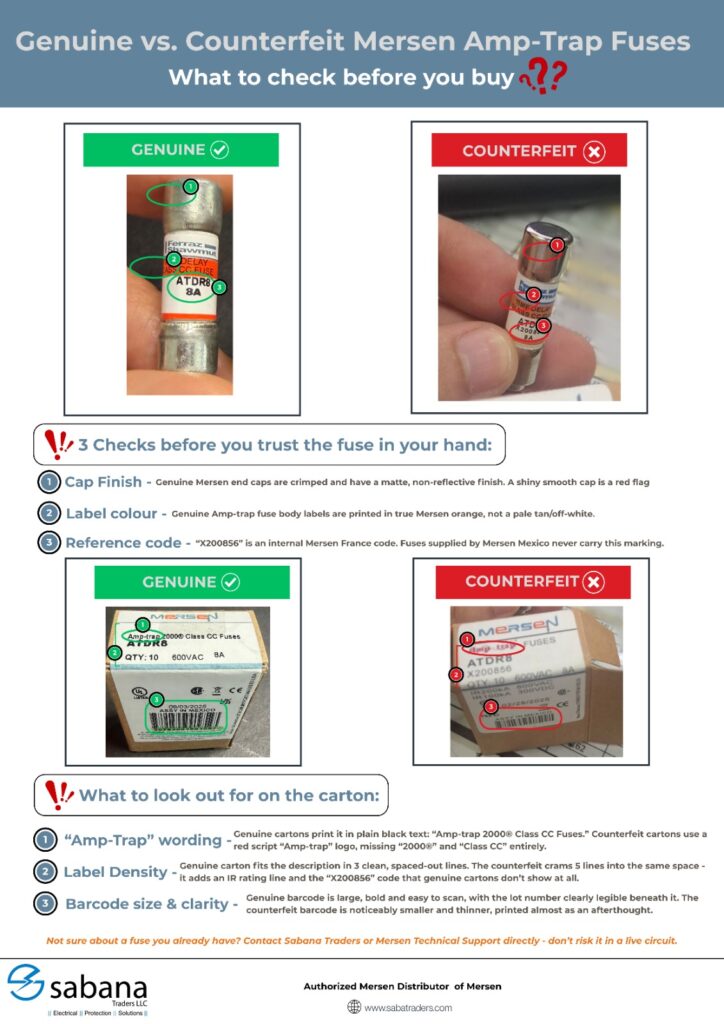
Electrical safety best practices only work when the protection equipment behind them is chosen with the same care as the procedures themselves. For guidance on picking the right fuse class in the first place, see our fuse selection guide, and for how protection fits into the wider distribution system, see our electrical system design guide. Sabana Traders supplies genuine Mersen and SIBA protection products across the UAE and GCC, with technical support to help facilities build safety into their electrical systems from the ground up.


© 2025 Sabana Traders LLC. All Rights Reserved | Developed and Managed by ysofttek.com
WhatsApp us